AMAGE — AI portal, models and features: an introduction
AI systems — possible use cases
AI systems are used in virtually every industry — from manufacturing and maintenance operations, through construction and logistics, to administration, finance, and customer support. In organizations, they can help analyze and process documents (contracts, purchase orders, reports, correspondence), automate classification and information workflows, build intelligent knowledge bases, and provide conversational user support (chatbots and assistants). AI also enables event prediction (e.g., failures, delays, risks), process and schedule optimization, anomaly detection, and better decision‑making by combining data from many systems and interpreting it in the context of business processes.
AI at AMAGE Systems — use cases and capabilities within AMAGE solutions
AMAGE solutions have supported organizations in maintenance and operational process management for years. This is a natural environment for AI‑driven automation and decision support, because AMAGE systems contain repeatable processes, a large volume of documentation, and a single source of truth about the state of assets, requests, and work.
The most valuable element for AI deployments in AMAGE is the combination of two data areas: asset structure (equipment, installations, facilities, locations, relationships) and documentation (manuals, protocols, standards, reports, service history). This well‑structured knowledge becomes a foundation for AI agents that:
- find information in documentation and incident history faster,
- suggest decisions in the context of a specific asset and its current state,
- prepare proposed actions (e.g., checklists, work orders, inspection plans) and — within an agreed scope — can also execute selected steps.
AMAGE AI’s agent‑based architecture makes it possible to use data directly from AMAGE instances as a reliable working context (e.g., current parameters, statuses, relationships, schedules, responsibilities). At the same time, the platform can combine this context with other data sources — depending on organizational needs — such as ERP systems, BMS/SCADA, document repositories, email, procedure databases, sensor data, or event logs.
It is critical for such AI deployments to behave in a predictable and controllable way: we enable designing agent behavior rules, defining the scope of their competencies, and setting action‑taking policies. Data privacy and security are equally important, especially in critical industries (energy, transport, infrastructure, strategic manufacturing). That is why AMAGE AI solutions can be deployed in models tailored to customer requirements — from cloud, through private cloud, all the way to fully on‑premises.
AMAGE AI Platform
The AMAGE AI Platform is a central system for building, running, and supervising AI solutions in the AMAGE ecosystem. It provides one coherent environment where an organization can combine process data and documentation, design agent behavior, and deliver secure, contextual AI support to users — exactly where the work happens.
The solution is designed and developed wholly by ourselves, which translates into real flexibility to tailor the platform to a customer’s industry and processes: integration with existing systems, configuration of permissions and security policies, and expansion of modules and automations as needs evolve.
The platform acts as a “hub” that integrates AMAGE‑based systems into a central AI analytics and automation layer, enabling, among others:
- consistent management of AI solutions across multiple areas and AMAGE instances,
- using operational data and organizational knowledge as reliable execution context,
- controlled agent deployment (scope, rules of operation, auditability),
- evolving from simple assistants and knowledge search to automation of selected processes.
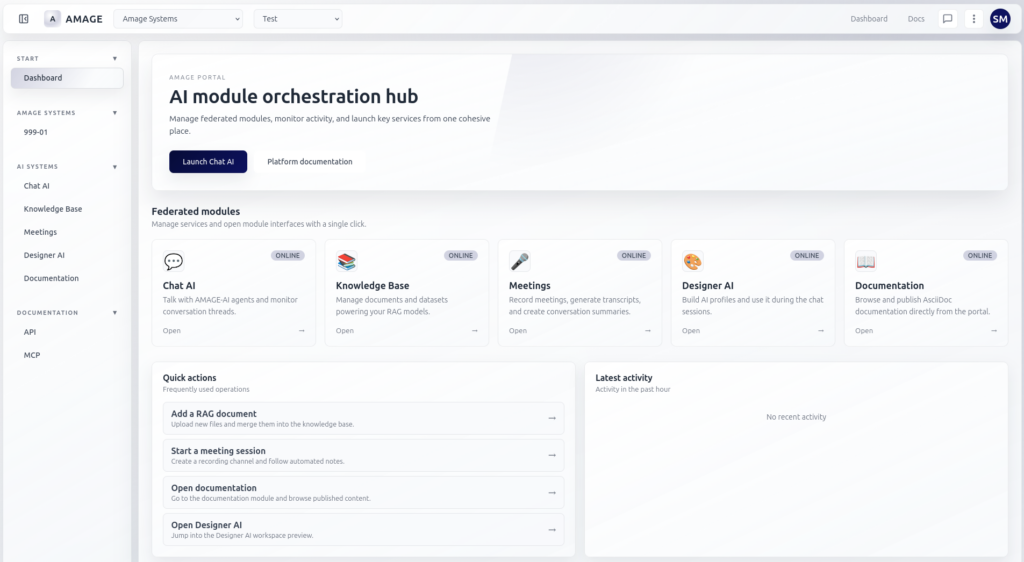
The AMAGE AI Platform can support multiple organizations and projects within a single installation (multi‑tenant), providing full isolation of data and configuration between environments. This makes centralized platform maintenance easier while preserving security requirements: separate users, roles, permissions, and access control to modules and assets.
The platform includes built‑in applications that support day‑to‑day work with AI and organizational knowledge, including:
- a meetings and notes space (organizing decisions, conclusions, and tasks),
- a knowledge base (collecting and indexing documents and sources),
- chatbot / conversational assistants,
- integrations with AMAGE instances and other systems (providing context and data to agents).
At the core is the AMAGE AI backend — the layer responsible for model management and usage, configuration of conversation profiles and AI agents, as well as building and analyzing knowledge bases. The backend also enables defining data structures and automation rules, so AI solutions remain aligned with business processes and controllable in production.
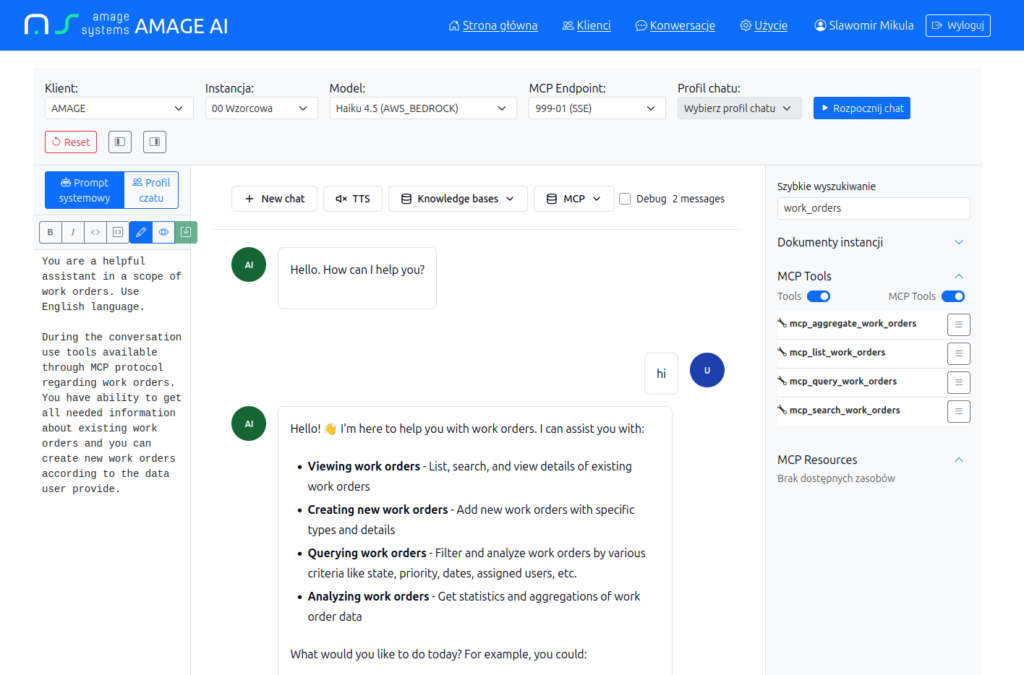
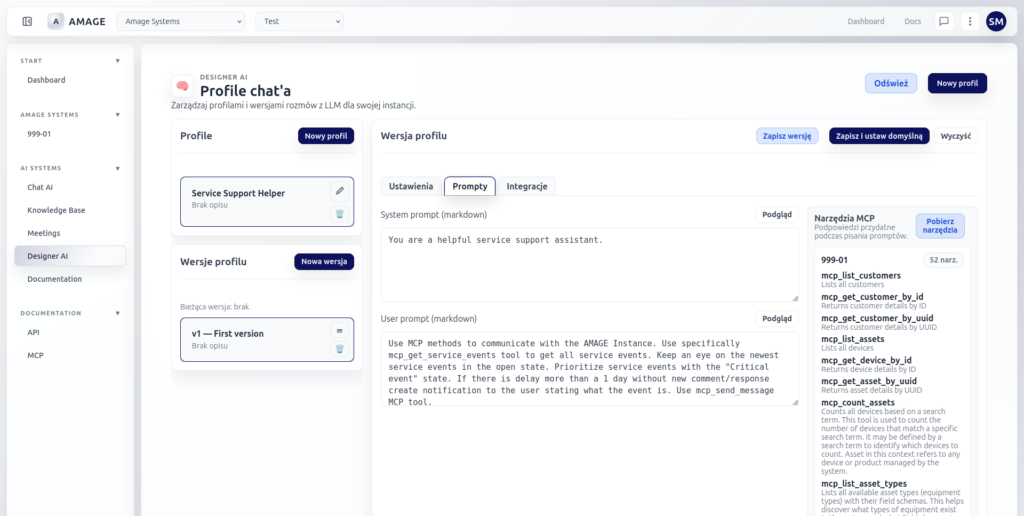
AMAGE AI includes a prompt, conversation profile, and agent designer that lets you define assistant behavior in a structured way: role, scope of competencies, context sources, response style, and security rules. This makes it possible to configure and test conversational mechanisms before releasing them to users — without manually maintaining multiple prompt variants and without the risk of inconsistent settings across environments.
Ready configurations can be published as conversation profiles and agents for a selected organization or project, with access control and permissions. This simplifies rollouts in larger organizations where different teams need different assistants (e.g., maintenance, administration, documentation, procurement) while still following shared standards.
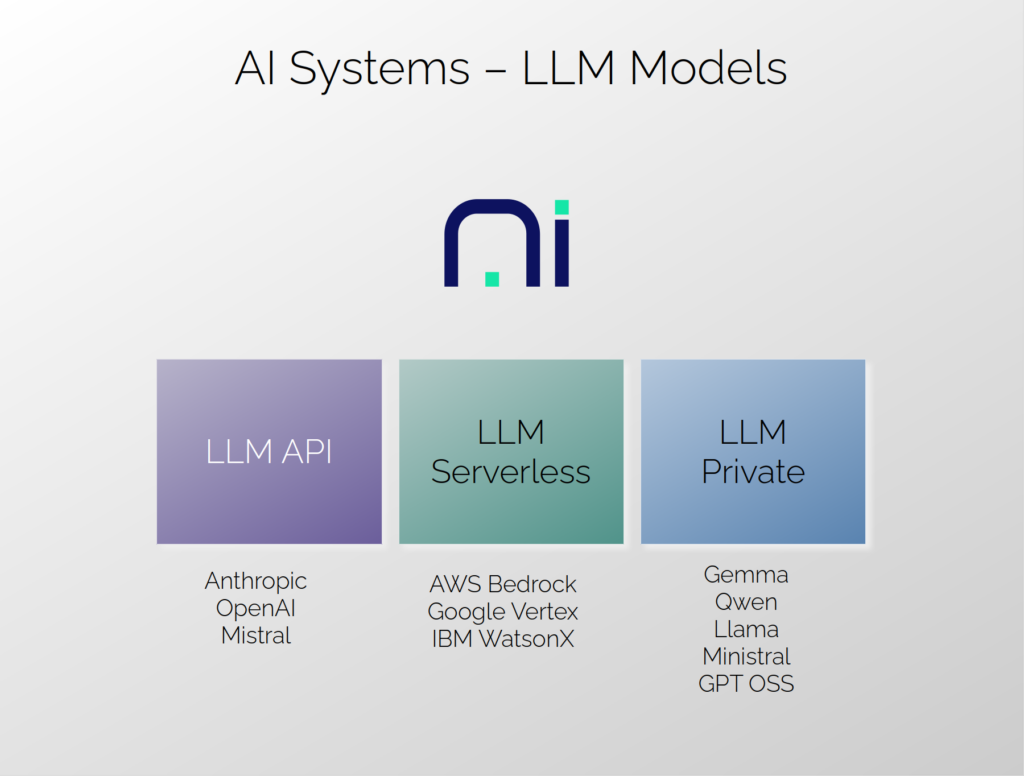
The platform also enables defining and using large language models (LLMs) in a form that best fits customer requirements:
- models exposed via API,
- serverless cloud services,
- models running on dedicated infrastructure (including open models on the customer’s hardware).
All components can be deployed in several available models, including fully isolated deployments on the customer’s infrastructure (On‑Premises).
Deployment options
The AMAGE AI Platform can be deployed in a model tailored to an organization’s requirements — both in terms of data privacy and integration with existing IT infrastructure. Choosing a deployment variant helps balance time‑to‑launch, operating costs, scalability, and the level of control over data and the AI models being used.
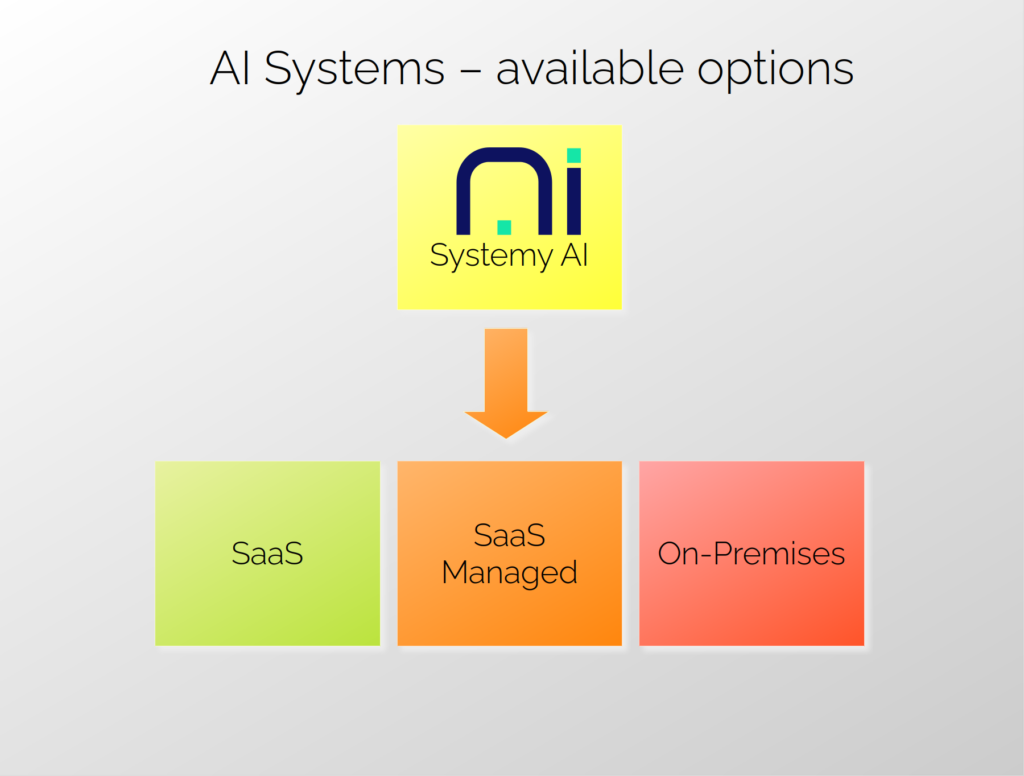
In practice, we offer three proven deployment models:
- SaaS (AMAGE public cloud) — fastest start and easy scaling without infrastructure investment.
- PaaS (private/dedicated cloud) — more control, dedicated resources, and integrations tailored to the customer environment.
- On‑Premises (customer infrastructure) — full isolation and control, recommended for the highest security and regulatory requirements.
Each model can include integrations with AMAGE systems and external systems, and can use LLMs either in the cloud or on the customer’s infrastructure — depending on security policies, available resources, and the desired level of independence.
Cloud solutions (SaaS)
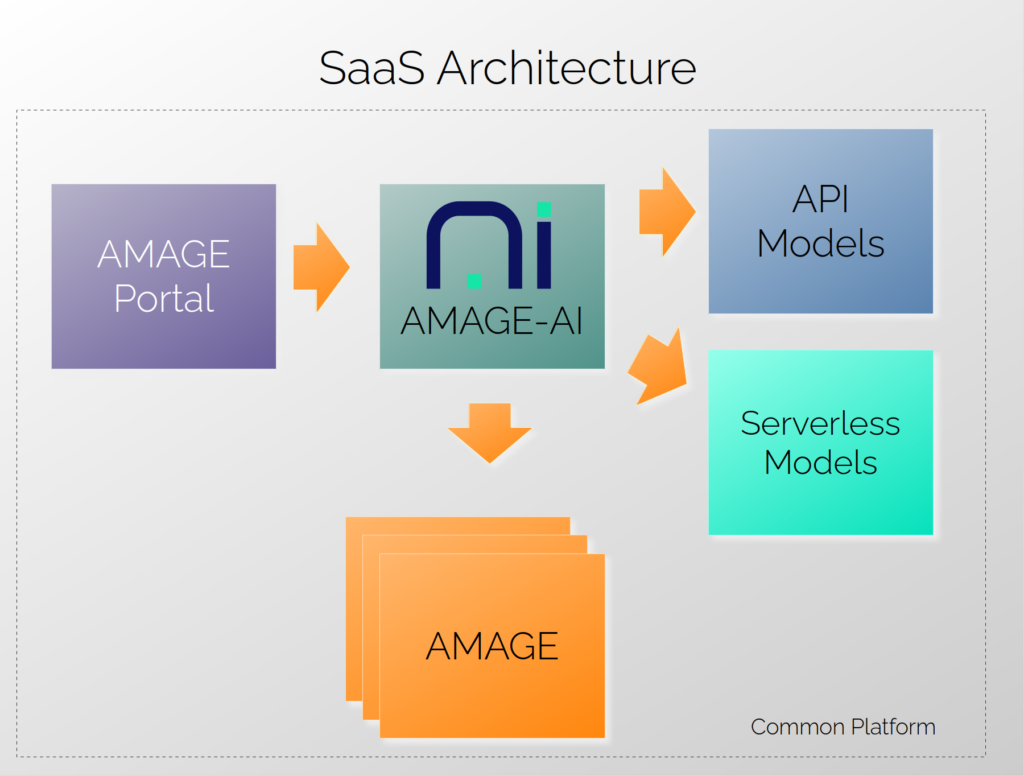
The SaaS model is the fastest way to launch AMAGE AI in an organization — without infrastructure investment and without a long preparation stage. The platform runs in a managed AMAGE AI cloud environment, and the customer gets a ready, scalable solution that can be quickly integrated with selected data sources and processes.
SaaS works especially well for pilot deployments and whenever short time‑to‑value and development flexibility are key. Depending on requirements, it is possible to use LLMs delivered as cloud services (serverless/API) while preserving access control and profile/agent configuration policies.
Key benefits of the SaaS model:
- fast deployment and a low entry barrier (no on‑prem servers required),
- scalability as the number of users and workloads grows,
- predictable costs for operations and updates on the provider side,
- a good fit for organizations with lower infrastructure isolation requirements, while still keeping permission and configuration control within the platform.
Private cloud solutions (PaaS)
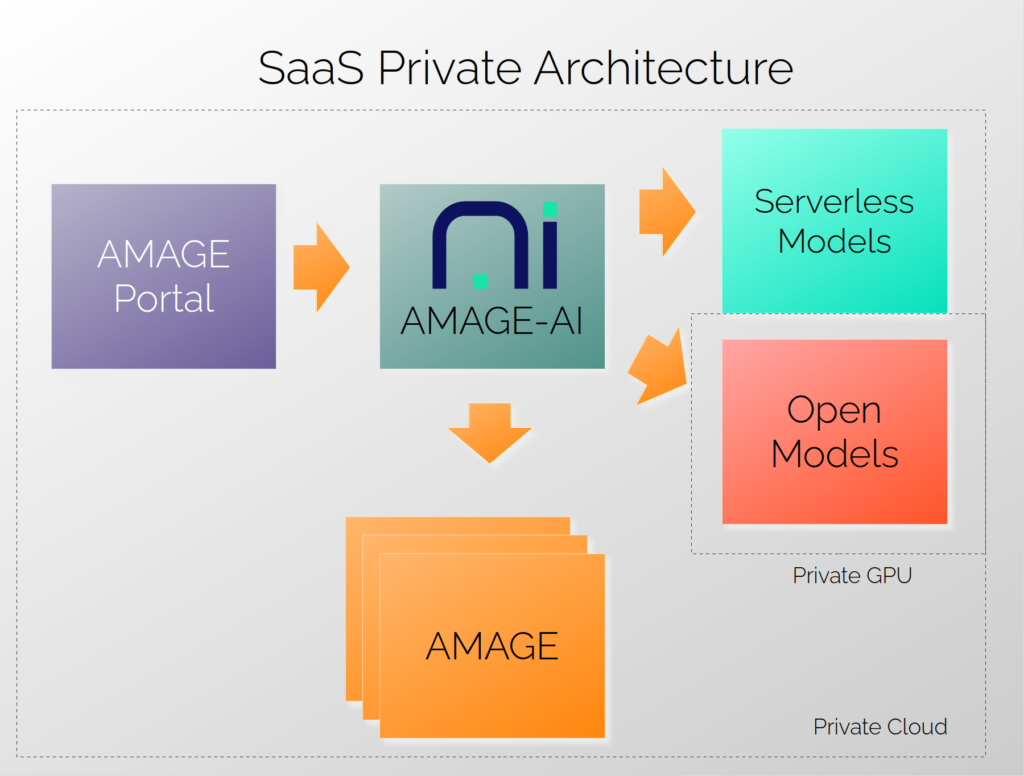
The PaaS model (private or dedicated cloud) is designed for organizations that require more control over the environment than SaaS, while still keeping the benefits of cloud: scalability, automated operations, and fast expansion. AMAGE AI runs on dedicated cloud infrastructure designed for the customer’s requirements (architecture, network, isolation, access policies, integrations).
PaaS enables the use of both serverless/API models and customer‑owned AI model instances running on dedicated resources (GPU/TPU) and inference servers (e.g., vLLM, Ollama) — which helps tailor the solution to performance requirements, cost constraints, and security policies.
Key benefits of the PaaS model:
- greater isolation and control over the environment (compared to SaaS),
- dedicated resources and the ability to precisely size infrastructure to workloads,
- easier fulfillment of security and compliance requirements (network policies, access, logging, audit),
- broad integration options with customer systems and existing IT landscape.
Private deployments (On‑Premises)
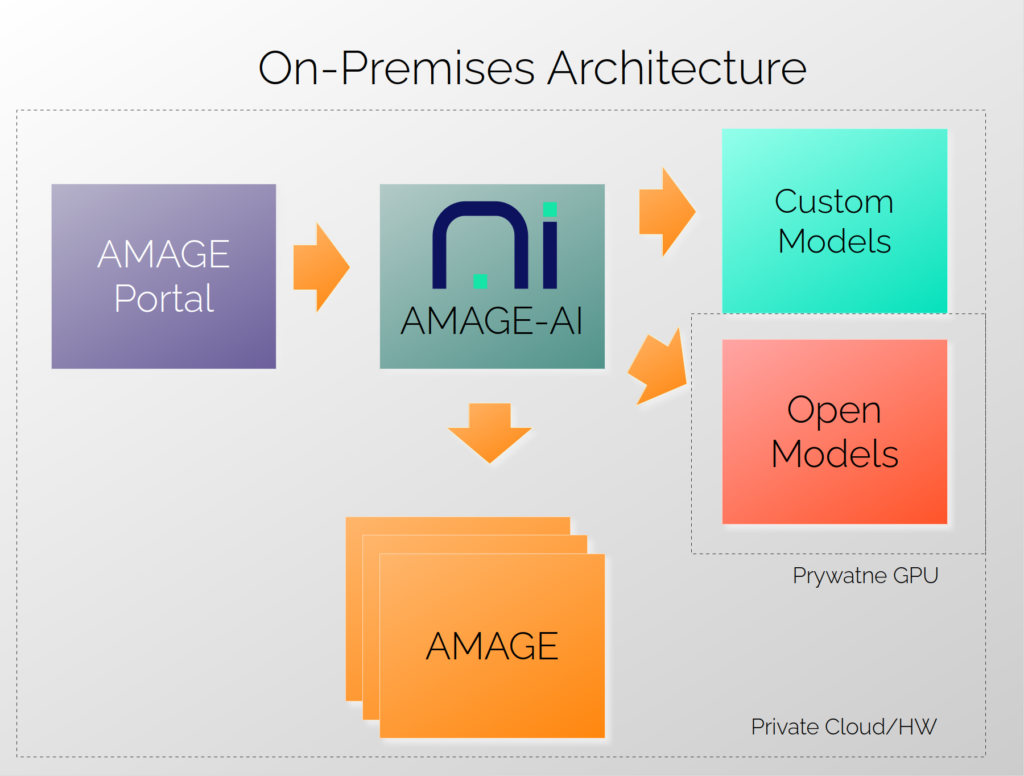
The On‑Premises model deploys AMAGE AI fully within the customer environment — on local servers or in the organization’s private cloud. This variant is intended for entities that require maximum control over data, network traffic, and how information is processed (e.g., regulated environments, critical infrastructure, organizations with a “no cloud” policy, or air‑gapped networks).
On‑Premises supports running customer‑owned AI model instances on customer resources (e.g., GPU/TPU) and using customer‑managed inference servers (e.g., vLLM, Ollama). Depending on needs, the solution can also include preparing and maintaining models in the customer environment, including fine‑tuning on internal data — without moving data outside the organization.
Key benefits of the On‑Premises model:
- full control over infrastructure, data, and environment configuration,
- ability to operate in isolated networks and under strict security policies,
- local model execution and inference (predictability, compliance requirements),
- an option to fine‑tune models on customer data in a controlled environment,
- best fit for organizations with the highest privacy and security requirements.
Features and capabilities
The AMAGE AI Platform provides a complete set of tools for practical AI use within an organization — from working with documentation and knowledge, through conversational assistants, to agent‑based process automation. Thanks to integration with AMAGE Software Suite, AI solutions can run on data and processes already operating in the organization, without duplicating information and without losing operational context.
Key capabilities include:
- document processing and analysis and knowledge‑base building (search, summaries, classification, contextual answers),
- business assistants and chatbots grounded in real organizational data and access policies,
- model and conversation profile configuration aligned with user roles and use cases,
- agent‑based task execution and process support (within an agreed scope: recommendations, action preparation, automations),
- integrations with AMAGE instances and external systems so AI works with current, reliable context.
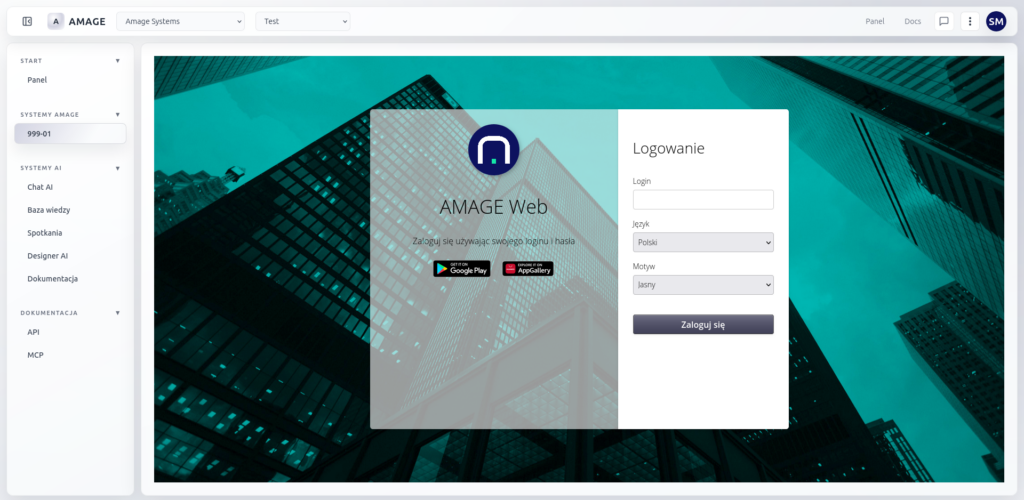
Document, knowledge base, meeting, and report processing
AMAGE AI helps organizations handle large volumes of content — from technical documentation and procedures, through correspondence and reports, to meeting materials. The platform automates information organization, key data extraction, and knowledge‑base creation, so users can find answers faster and make decisions based on current, verified context.
Key capabilities include:
- information extraction from documents (e.g., data, parameters, identifiers, decisions, responsibilities) and structuring the results,
- summaries and briefs tailored to the user’s role (management, operations, engineering/technical),
- classification and tagging of documents and automatic assignment to topic areas,
- contextual Q&A using advanced RAG (Retrieval‑Augmented Generation), i.e., combining an LLM with knowledge‑base retrieval,
- working with meeting content (notes, conclusions, action items) and linking it to processes and documentation.
Business conversational AI systems
AMAGE AI enables building business conversational assistants that respond based on organizational knowledge and the user’s current work context. Unlike generic chatbots, assistants in AMAGE AI can operate on defined data sources (documentation, knowledge bases, AMAGE processes, integrations) and within access policies — making them useful in daily work and predictable in corporate environments.
The platform lets you configure assistants for specific roles and use cases (e.g., maintenance operations support, compliance/legal, production data), including:
- answers based on knowledge bases and customer data (RAG) plus selected public/general sources,
- integrations with AMAGE instances and external services via MCP servers and connectors,
- configurable conversation profiles (language, style, answer format, constraints, security rules),
- permission and data visibility control so users get responses consistent with their role,
- the ability to evolve from simple Q&A to process‑support assistants (e.g., preparing a summary, gathering data, proposing next steps).
Personalized AI models
With AMAGE AI, it is possible to create and maintain personalized model solutions tailored to an organization’s specifics — its terminology, document types, processes, and quality requirements. Depending on needs, this can mean configuring models for specific tasks (e.g., data extraction, classification, content analysis) or preparing assistant variants that rely on dedicated knowledge context.
The platform supports evolving AI solutions toward higher precision and automation, including by:
- building and growing knowledge bases (RAG) and enhancing them with multimodal processing of documents: text, images, video, and audio,
- using specialized models for tasks such as field extraction, element detection in documents, compliance analysis, and data quality checks,
- running models in the cloud or on customer infrastructure (aligned with security requirements),
- tailoring AI configuration and components to specific use cases (e.g., technical documents, reports, forms, correspondence).
Agentic AI systems
The agentic approach in AMAGE AI makes it possible to move from a “question‑answering assistant” to solutions that carry out tasks under defined rules and permissions. Agents can analyze context, plan steps, use knowledge, and perform actions in AMAGE systems and external systems — always within an agreed scope and with control options (e.g., approvals, action logs, audits).
The platform enables designing agents that support operational and administrative processes, including:
- defining agents to perform tasks and process stages (e.g., preparing a proposed work order, checklist, or report),
- integrations with AMAGE and external systems so the agent can work on current data (e.g., ERP, BMS/SCADA, document repositories),
- automating routine activities (information gathering, comparisons, validations, preparing input data),
- decision support based on asset context, documentation, and incident history,
- ability to enforce operating rules (competencies, limits, required confirmations) for predictability and safety.
Integration with AMAGE Software Suite
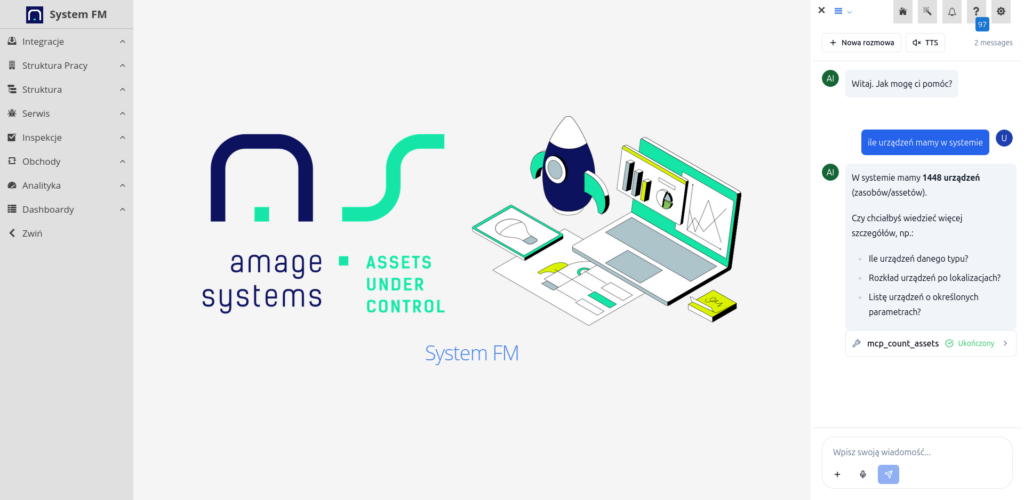
Integrating AMAGE AI with AMAGE Software Suite makes it possible to embed artificial intelligence directly into operational processes — so assistants and agents work on the same data as system users. This way, AI is not a “separate tool”, but an extension of the AMAGE environment with knowledge search, contextual analytics, and action automation.
The connection is implemented via integration mechanisms (including MCP protocols), which securely exposes context from multiple AMAGE areas and instances. In practice, the integration includes:
- access to AMAGE process data (e.g., assets, requests, work orders, schedules, inspections) as conversation and agent execution context,
- indexing documentation and the AMAGE system structure in AI knowledge bases so answers rely on trusted sources,
- permission control and data isolation aligned with user roles and organizational policies.
Integration inside AMAGE
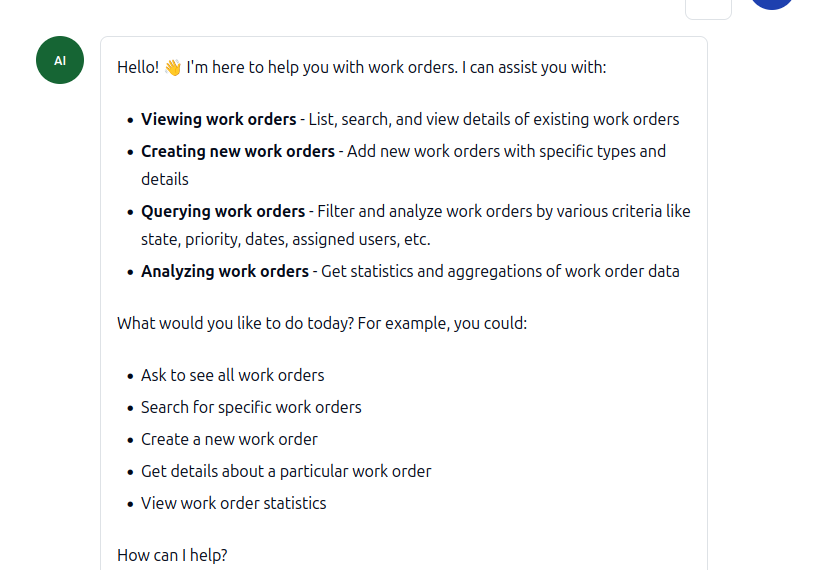
AMAGE AI can run directly inside AMAGE systems, providing conversational support right where operational tasks are performed. This means employees do not have to switch between tools: the assistant has access to the current context (e.g., a selected asset, request, work order, document), and answers and recommendations are linked to real system data.
In practice, internal integration enables, among others:
- fast information lookup in documentation and knowledge bases without leaving AMAGE,
- analysis of data and incident history in the context of a specific facility/equipment item or process,
- preparing summaries, notes, and proposed actions (e.g., checklists, diagnostic steps, request descriptions),
- user support in daily work through assistants tailored to roles and permissions.
Multiple AMAGE instance integrations within the AMAGE AI Platform
In organizations with multiple sites, subsidiaries, or projects, AMAGE AI can serve as a central AI platform for many AMAGE system instances. This allows you to deploy and maintain AI solutions in one place while using data and context from different environments — in line with access policies and security requirements.
This approach enables, among others:
- coordinating and standardizing how assistants and agents operate across the organization (shared standards, profiles, policies),
- building shared or separated knowledge bases and using data from many instances as analytical context,
- supporting multi‑site work (comparisons, reporting, sharing best practices, consistent definitions),
- managing integrations and permissions centrally while maintaining data isolation between organizations/projects where required.
Example use cases
Below are example AMAGE AI deployment scenarios showing how the platform combines process data, documentation, and agentic automations in practical applications. The selected features and automation scope depend on organizational needs — from quick access to knowledge and user support to analytics and task execution in operational processes.
Deployment areas may include, for example:
- maintenance support (diagnostics, procedures, service history, planning),
- construction investments and project delivery (working with documentation, reports, communication),
- document processing automation (data extraction, classification, workflows),
- agent‑based support for AMAGE users performing repeatable tasks.
Support in maintenance management systems
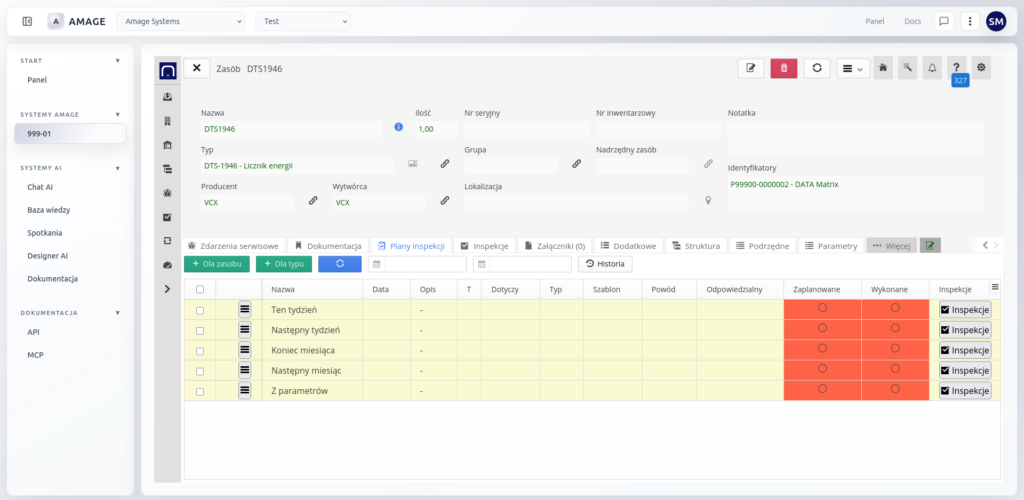
In maintenance, AMAGE AI helps reduce diagnostic time, improve decision quality, and minimize downtime by combining AMAGE operational data (requests, work orders, service history, assets) with technical documentation and organizational knowledge. Assistants and agents can support planning and analytics as well as day‑to‑day field work.
Example use cases include:
- automated analysis of requests and failure history (classification, likely cause suggestions, prioritization, documentation lookup),
- failure prediction and anomaly detection based on sensor data and monitoring systems,
- procedure, checklist, and diagnostic step recommendations in the context of a specific device and its condition,
- optimizing inspection and work schedules (better resource planning, shorter service windows),
- fast documentation lookup and interpretation (manuals, protocols, standards, reports) without leaving the process,
- preparing proposed service actions (work order description, scope of work, parts list) for approval and execution.
Support in construction investment management systems
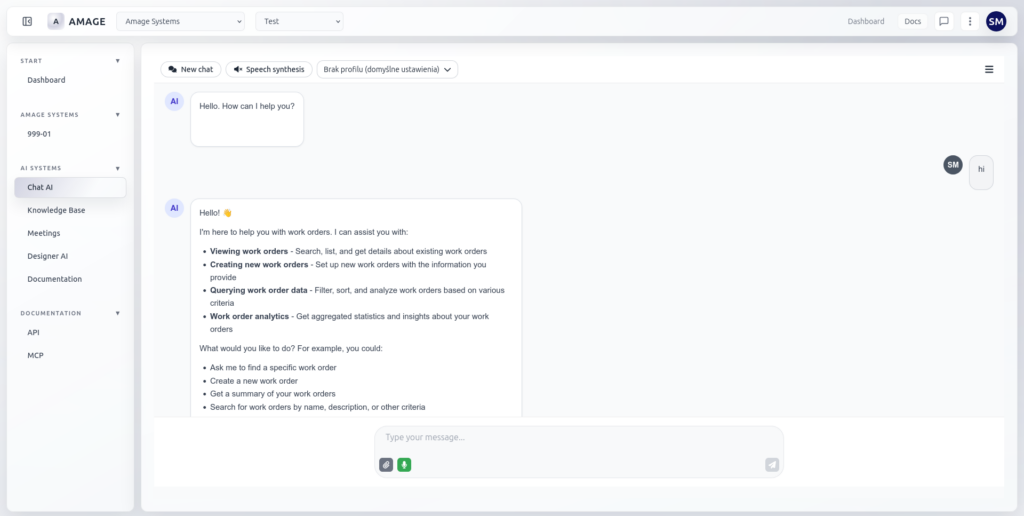
In construction projects, AMAGE AI streamlines team work by speeding up processing of documentation and project communication and improving information control throughout the investment lifecycle. Contextual assistants can combine process data (tasks, document workflows, statuses, decisions) with document content, making coordination easier and reducing the time needed to search for and verify information.
Example use cases include:
- automated analysis of design documentation and progress reports (summaries, change detection, risk and dependency identification),
- analysis of supervision module data, verification of progress and reported data, completeness checks, and schedule compliance analysis,
- procurement and logistics support: analysis of orders, deliveries, and equipment/material rentals (comparisons, completeness, statuses, alignment with agreements, rental calculations).
Document processing automation
AMAGE AI automates work with documents that are bottlenecks in many organizations: deliveries, purchase orders, warehouse documents, as well as legal and regulatory documents. The platform can extract information from content, organize it, and pass it to the appropriate modules and processes — reducing manual data entry and the risk of errors.
Example use cases include:
- processing delivery documents (e.g., invoices, dispatch notes, specifications): data extraction from scanned documents, completeness checks, and linking with purchase orders, deliveries, and inventory,
- analyzing legal and regulatory documents: key information extraction (e.g., deadlines, obligations, scopes, references) and passing it to compliance/legal modules for further workflow and reporting.
Agent systems supporting AMAGE users
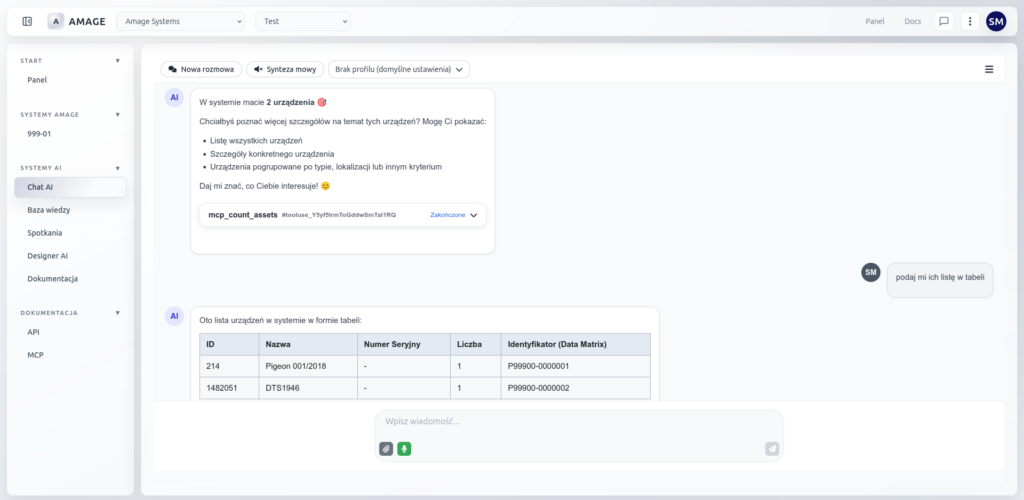
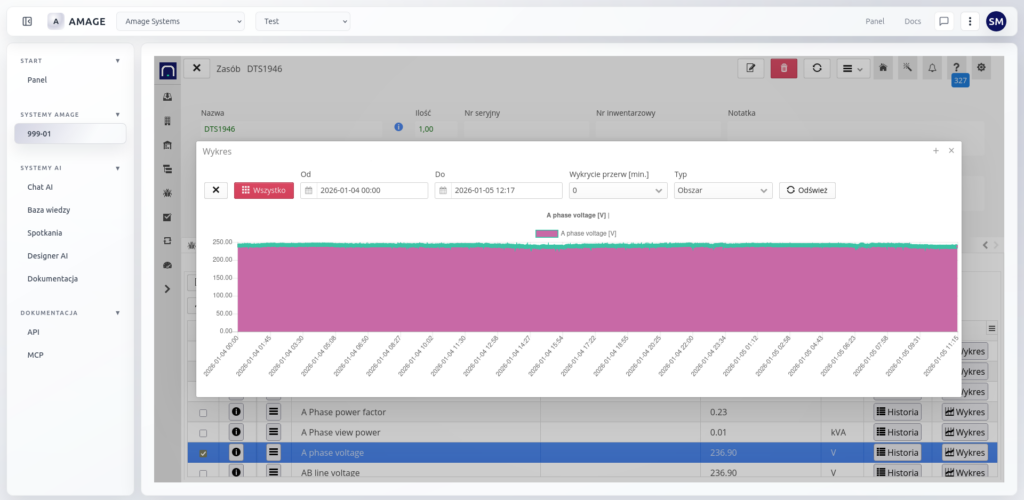
In this scenario, AMAGE AI operates as a set of agents supporting users in day‑to‑day tasks within AMAGE systems. Agents can not only answer questions but also prepare actions and carry out agreed steps in processes — based on operational data, documentation, and defined access rules.
Example use cases include:
- defining agents to perform specific tasks and process stages (e.g., preparing a work order, validating data, drafting a checklist, generating a summary),
- automating routine activities and decision support (e.g., collecting information from multiple modules, comparisons, identifying gaps and risks),
- combining multiple conversation profiles and agents to handle more complex business processes (e.g., a “technical assistant” + “documentation assistant” + “integration agent” working in a single flow).
Summary
AMAGE AI solutions enable practical use of artificial intelligence across an organization — from working with documentation and knowledge bases, through conversational assistants, to agent‑based process automation. The key value is combining AI with AMAGE operational data (assets, events, work orders, schedules) and documentation, which enables answers and recommendations in the real work context.
The AMAGE AI Platform supports deployments tailored to customer requirements (SaaS / PaaS / On‑Premises), with an emphasis on security, access control, and scalability. This allows organizations to evolve AI solutions step by step: from pilots and first assistants to automating selected processes.
If you’d like to discuss AMAGE AI deployment scenarios for your organization (scope, integrations, infrastructure model), contact us — we will prepare an architecture proposal and an implementation plan aligned with your needs and security policies.